Skip to content
    • About
    • Contact
    • work with Ben

Stroke and mirrors

  • The questions -sticky post

    Dec 15th, 2023

    Last Updated in may 2026, 3 years post stroke.

    A lot of times people start to ask questions then either stop or apologised as they think it might be inappropriate so I’ve compiled them and answered as well as I can; I try to be as open as possible because if I can’t own this situation who can?

    So what exactly did happen?

    I’m still not 100%, I don’t think I ever will be; from what I’ve pieced together I went for elective cardiac surgery, keyhole through my ribs assured I needed it and how safe it was. When I came round after the operation in CICU (cardiac intensive care) , I couldn’t really move or speak and became distressed, my husband with me early on could tell my frustrations, hours later neurological observations were done and a medical opinion sought. I was laid in a bed immobile, unable to communicate and very aware I was experiencing a neurological event; scratching letters into my husbands hand to try and communicate that I needed help. Come the evening I had a head scan, reviewed by the city neurology team who said it was too late by that time to do any interventional treatment.

    How’s recovery?

    Slow and frustrating. I shouldn’t gloss over the big achievements like learning to stand or walk or talk after spending my early weeks completely immobile and essentially mute or being able to walk long distances again but my walk still requires far more effort than it should, it looks bad and is slow. I wear an ankle and foot orthotic support to help my walking but it’s ugly and I dislike it. My arm still being useless is a bigger frustration , to see the leg develop and not the arm feels cruel, I am still seeing some progression, I can get a bits of movement from the shoulder, a tiny bit of hand closure but no extension some minimal bicep and tricep movement.

    What’s rehab now ?

    I still do a lot of stretching every day, I do a minimum of 4000 steps a day. I try to do hydrotherapy for an hour a week, alas the local pool has been broken for many months . I see a specialist physio for soft tissue muscular massage once a month, I’m not sure it makes the biggest difference but she’s got a great knowledge and it feels so good during and afterwards, I have noted the arm movement difference happens the day after sessions there, maybe that’s it working (I hope) I see my private Neuro physio alternate weeks for an hour at large expense and each time we build and make some level of progress .

    A while back I did try robotic therapy combined with private physio which sounded promising and I love a bit of tech, but it was so expensive and time consuming it wasn’t sustainable. I recently got sign off to try some muscular electrical stimulation machines we thought we off limits so frequently slap a big old battery on my arm and let it go

    What about work?

    I returned to my original work just under a year after the stroke, about a year later I accepted I couldn’t physically do the clinical work and despite persevering the mental toll was too much so I decided to change paths, it broke my heart, I long to scrub and be at an operating table again. But I’ve found something that almost feels custom created for me at this point in my life

    Are you claiming / suing?

    That’s not a question for here

    Aren’t you angry?

    Well obviously I’m not happy. I went from being the physically healthiest I’d ever been (minor cardiac issues aside) to being paralysed for a while and briefly in a wheelchair, but not ‘angry’ per se. This was an unfortunate accident I was the <1% risk chance , being angry won’t change the outcome or where I am. Ive had to learn the anger was ok to feel but ultimately unhelpful
  • Better luck next time

    Oct 6th, 2026

    Yesterday, somebody drove into my car.

    It was an odd situation. I was driving behind a hesitant learner who moved into a right-turn filter lane, then unexpectedly moved back into the main carriageway and hit me. It turned out they were on their driving test, so there was a driving examiner sitting beside them.

    What happened involved a borrowed car, temporary insurance, the vehicle owner arriving at the roadside, and eventually the examiner’s manager arriving too. It was, objectively, a bit of a circus.

    But the thing I’ve been thinking about since isn’t really the accident.

    It’s how I responded to it.

    Not that long ago, a sudden stressful situation like that would have brought very high emotion with it. I might have become overwhelmed by what had happened, lost some of my ability to think clearly, or been so focused on the emotions that I didn’t collect the information I’d later need.

    Yesterday, I didn’t.

    I stayed calm. I stayed physically and mentally engaged with what was happening. I asked questions. I photographed the insurance certificate, got the policy number and vehicle owner’s details, made sure I had what I reasonably could, and later passed everything to my insurer.

    I wasn’t emotionless. That’s not the achievement.

    I was regulated enough to remain useful to myself.

    Afterwards, predictably, my brain started auditing my performance. I hadn’t taken the driving examiner’s details. Had I missed something else? Was the temporary insurance legitimate? How was anyone going to unravel all of this?

    Then I realised something else.

    That isn’t my job.

    My responsibility was to deal with the immediate situation, gather the information available to me, record what happened and report it. I had done that. The investigation and resolution now belong to my insurer.

    There are things I’d do differently if it happened again. There almost always are. But learning from something doesn’t require deciding that you handled it badly.

    In fact, this showed me something I probably wouldn’t otherwise have noticed: I’ve changed.

    Progress isn’t always visible while you’re making it. Sometimes you discover it when life abruptly tests a skill you didn’t realise you’d been developing.

    Yesterday gave me that test.

    I kept my cool. I advocated for myself. I collected what I needed. And, importantly, I have recognised where my responsibility ends.

    As I left, I waved to the learner and said, “Better luck next time.”

    With hindsight, perhaps that applies to both of us.

    He gets another go at his driving test.

    And I got unexpected evidence that proves I’m becoming better at navigating life again.

  • Hidden holiday costs

    Sep 11th, 2026

    Looking through my holiday photos, you would struggle to spot my disability.

    You’d see cruise ports . A cruise ship. Nice food. Days out. The occasional cup of tea and more frequent beer. You’d probably conclude that I had a good holiday, and you’d be right.

    What the photos don’t show are the hundreds of tiny reminders that disability never goes on holiday.

    The holiday was brilliant .

    The disability came with me.

    Before we even left, there was the planning. Most people book a holiday and start looking forward to it. I find myself thinking about medication, assistance, transfers, access, walking distances, fatigue and what would happen if things went wrong. None of it is especially dramatic, but it adds a layer of background stress before the holiday has even begun.

    Part of that stress comes from relying on other people. As a self confessed control freak I like to be organised. I like to know what’s happening. I like being independent. Travel has a way of taking some of that away. I’m stuck  relying on other people to carry things, move things, organise things or simply help me get from A to B. The holiday starts long before the departures.

    Then there’s security.

    For most travellers, airport security is a minor inconvenience. Queue up, empty your pockets, walk through the scanner, carry on with your day.

    For me it becomes a whole olympic style  event.

    I can’t go through the scanner. I can’t fully participate in a pat-down because pmy body simply doesnt  cooperate. Extra, often awkward,  explanations are required. Alternative arrangements are made. Staff are invariably polite and professional; often quite sympathetic; but I still end up feeling like a problem that needs solving rather than a passenger who needs processing.

    It lasts a few minutes.

    The feeling  lasts longer.

    One thing I’m always conscious of is feeling that I’m in the way.

    Busy stations. Airports. Crowded streets. Ship corridors. Anywhere with people moving quickly.

    I’m constantly checking over my shoulder.

    Constantly aware that I’m slower than the people around me.

    Constantly wondering whether I’m inconveniencing someone.

    Most people probably haven’t even noticed me. Yet there I am apologising for existing at a different speed to everyone else.

    “Sorry I’m slow.”

    “please go ahead”

    Sorry I’m taking up space.

    Sorry.

    The reality is that a lot of disability isn’t physical. It’s the mental load that comes from navigating the world while trying not to inconvenience it.

    Then there are the compromises that nobody sees.

    I couldn’t simply throw a hoodie in my bag or tie it around my shoulders  “just in case”. What I bring, what I wear and what I carry are all influenced by what I can physically manage. Every item has a cost.

    The same applies to activities.

    One of the strange things about disability is that something can be completely accessible and still not really be available to you.

    The swimming pools were right there.

    The buffet was right there.

    The various activities and opportunities to dash around were right there.

    I could see them all and get there albeit slowly

    That doesn’t necessarily mean I could use them in the same way as everyone else.

    Accessibility and participation are not the same thing.

    I notice the tiny reminders.

    The ones that don’t make dramatic stories.

    The ones that happen every day.

    A good example came at dinner. I was sat in a  nice restaurant, having a tasty meal, enjoying my holiday, surrounded by people dressed for a formal  evening.

    Next to me , a family member was cutting up my food.

    Nothing was wrong.

    Nobody was making a fuss or even noticed

    I wasn’t upset.

    Yet it was another quiet reminder that there are parts of life I still can’t do for myself.

    The thing is, none of this ruined the holiday.

    Not remotely.

    I had a fantastic time; I walked 13,000 steps for 4 consecutive days, I went on boat tours, ferrys, sat in pubs and cafes

    That’s actually the point.

    Disability doesn’t disappear because you’re somewhere nice.

    It doesn’t stay at home while you go away.

    It follows you through airports, restaurants, city streets and cruise ships. Sometimes loudly. More often quietly.

    When people look at the photos they’ll see the good bits.

    They’ll see exactly what I saw.

    What they won’t see are the hidden costs that came with them.

    The strange thing is that I’m okay with that.

    The photos aren’t lying.

    They’re just incomplete.

  • Energy and future Ben

    Aug 24th, 2026

    Recently, while busy someone close to me made an observation that stopped me for a moment.

    “You work, you drive, you do hydrotherapy, you go to the gym, you do physio, you play sport. You’ve still got heart disease and you’ve had a stroke. You don’t have anything to prove.”

    It wasn’t a criticism . If anything, they were looking out for me.

    The thing is, I don’t think about those activities in the same way that many other people might.

    Most people would look at that list and see demands on time and energy. Work takes energy. Rehabilitation takes energy. Exercise takes energy. Driving takes energy. Recovery takes energy.

    They’re right.

    But I don’t see those things as separate boxes. I see them as different routes towards the same destination.

    Hydrotherapy isn’t something I do because I enjoy the process but I do enjoy an hour chatting in a warm pool . The gym isn’t something I do because I enjoy feeling tired and achy afterwards. Physio isn’t something I do because I was struggling to find a way to spend my evening and my money .

    I do them because they all contribute to the same goal: maintaining as much function, independence and quality of life as possible.

    That doesn’t mean I spend every waking moment trying to optimise myself.

    In fact, one of the biggest decisions I made after the stroke was to move to a part-time work role .

    Some people might see that as doing less. For me, it was about creating enough space in to do all the things that matter. Rehabilitation appointments. Exercise. Family. Recovery. Reading. The occasional afternoon where the most demanding task is deciding whether to make another cup of tea.

    I learned quite quickly that work couldn’t be the only thing in my diary.

    Recovery needs time.

    Maintenance needs time.

    Sometimes doing absolutely nothing needs time.

    There are days when the best thing I can do is stop. Put my kindle in my hand. Have a bath. Go to bed early.

    Rest isn’t a reward earned through productivity.

    It’s part of the plan.

    When I replied to the observation , I said two things:

    “No-one’s going to do it for me.”

    and

    “It’s all my benefit.”

    That probably sounds harsher than I intended, but it’s true.

    Nobody can attend hydrotherapy on my behalf. Nobody can maintain my strength for me. Nobody can protect my future mobility by proxy.

    Those are things that only I can influence.

    A lot of this mindset comes from neuro rehabilitation itself.

    One of the recurring messages throughout rehabilitation is that repetitions matter.

    The brain learns through repetition.

    The body adapts through repetition.

    Recovery is often built on hundreds and thousands of small actions that, on their own, seem completely unremarkable.

    The older I’ve got, the less concerned I’ve become about where those repetitions happen and the more concerned I’ve become that they happen at all.

    Does it matter whether I achieve my daily steps at work, on a treadmill, walking around a supermarket or on a rugby pitch?

    Not really.

    What matters is that I did them.

    Four thousand steps is four thousand steps.

    The nervous system doesn’t award bonus points because the activity looked impressive. It doesn’t care whether the exercise was heroic, inspiring or social media worthy.

    The repetition happened.

    That’s what matters.

    There’s another important point, though.

    Not every worthwhile activity is measured in steps, exercise minutes or rehabilitation goals.

    Recently we hosted friends for the weekend. What was intended to be a pleasant catch-up turned into a long afternoon and evening filled with food, drinks, laughter and the sort of conversations that only happen when nobody is looking at the clock.

    The result was entirely predictable.

    It absolutely floored me.

    For the next couple of days I was tired, slower than usual and very aware that I wasn’t firing on all cylinders.

    If I looked at that weekend purely through the lens of energy management, I could argue that it was a poor decision.

    But I don’t see it that way.

    Future Ben didn’t just spend energy that weekend.

    He spent time with friends.

    He laughed.

    He enjoyed himself.

    He made memories.

    He lived his life.

    That matters too.

    Over time I’ve realised that rehabilitation and quality of life aren’t competing priorities. They’re intertwined.

    I don’t exercise so that I can exercise more.

    I exercise because it helps me do the things that make life enjoyable.

    Sometimes that’s a rugby session.

    Sometimes it’s travelling somewhere new.

    Sometimes it’s a meal out with family.

    Sometimes it’s a weekend with friends, even if I know I’ll be paying for it afterwards.

    Looking purely at the energy cost, that weekend probably wasn’t sensible.

    Looking at the quality of life gained, it was one of the best investments I’ve made all year.

    Future Ben wasn’t thanking me for the hangover.

    Future Ben was thankful for the memories.

    For that reason, I’ve never really bought into grind culture.

    I don’t want to outwork everybody.

    I don’t want to prove people wrong.

    I don’t want to collect stories about how hard I’ve pushed myself.

    The objective isn’t to do more than everyone else.

    The objective is to do enough that future me remains as healthy, independent and capable as possible.

    I’m also very aware there are people with similar diagnoses who can do far more than I can, and people with similar diagnoses who can do far less. This isn’t a guide for anybody else. It isn’t a scorecard, a competition or a benchmark.

    It’s simply how I’ve come to think about my own life.

    For me, activity isn’t about proving what I can do.

    It’s about giving future me the best chance possible.

    Because I’ve learned that today’s choices are often tomorrow’s reality.

    And more often than not, when I’m deciding whether something is worth doing, I don’t ask:

    “Do I feel like it?”

    I ask:

    “Will future Ben be glad that I did?”

    Most of the time, the answer is yes.

    Because rehabilitation gave me a reason to keep moving.

    But quality of life gave me somewhere worth moving towards

  • The punchlines

    Aug 17th, 2026

    My quick “funny” response isn’t really about being funny.

    It’s about getting there first.

    Before somebody can feel awkward, before somebody can pity me, before somebody starts searching for the right words, I’ve already acknowledged the situation and moved us on.

    A joke does that surprisingly effectively.

    Most people assume humour is about hiding discomfort.

    For me, it’s almost the opposite.

    The dead arm is obvious. The slower pace is obvious. The need for occasional help is obvious.

    The humour isn’t there to distract from reality. It’s there to acknowledge it quickly and stop it becoming the entire conversation.

    Someone gets stuck behind me in a corridor.

    “Go on ahead, you’ll be faster than I will.”

    Somebody offers me something else to carry.

    “My hand, singular, is full.”

    I offer to help somebody with a task.

    “Need a hand? Just one.”

    The joke lands, people laugh, and the moment passes.

    What could have become awkward instead becomes ordinary.

    I think that’s what I’ve come to value most about humour. Not that it changes the situation, because it doesn’t.

    It doesn’t make me walk faster.

    It doesn’t give me the use of my left hand back.

    It doesn’t make everyday tasks any easier.

    What it does do is give me control over how the moment unfolds.

    Rather than allowing disability to become the defining feature of an interaction, I get to acknowledge it, poke fun at it, and move on.

    There’s a certain power in that.

    Humour doesn’t give me my independence back.

    It gives me something almost as valuable:

    the ability to define the moment on my own terms.

    My stroke happened, it’s a large part of my life but it’s not the biggest factor.

  • Masks

    Aug 10th, 2026

    I’ve been thinking about masks.

    Not the physical kind. Not the pandemic kind. metaphorical kind.

    The one we carry around every day.

    The version of ourselves presented to the world.

    I suspect most people assume a mask exists to hide who we really are. To deceive. To keep people out.

    Mine doesn’t work like that.

    People often describe me as open. They’re right.

    I’ll talk about my stroke if you ask.

    I’ll talk all day about rugby.

    I’ll talk about the AFO attached to my leg and the defibrillator attached to my left tit .

    I’ll happily tell stories from my old career, stories from all stages of rehabilitation, stories from life now.

    I’ve never been particularly private.

    Yet despite being open, not everyone gets full access.

    That sounds contradictory but I’ve said before I know I am .

    People know things about me. Sometimes people know a lot of things. Yet there are people who know intimate details of my life and still don’t really know me at all.

    For years I assumed those two things were the same.

    Openness.

    Closeness.

    Visibility.

    Being known.

    They’re not.

    The realisation took a while

    If Someone asks about the AFO.

    Sometimes the answer is simple and short:

    “It’s a long story. I’d rather not.”

    Other times the answer takes an hour.

    The same question.

    A completely different response.

    The difference isn’t the story.

    The difference is the person asking.

    Trust is a strange concept. Most people assume it arrives through familiarity. Time served. Years known.

    It isnt always

    Some people I’ve known for many years still only know the public version of me.

    Others seem to arrive with a key

    They ask the right question in the right way .

    Listen properly to my answer.

    Ask a sensible follow-up

    And before I realise what’s happened, the mask lowers slightly.

    Never removed.

    Just lowered metaphorically to eye level

    Enough for them to glimpse something underneath.

    The odd thing is that I don’t think the mask exists for the reasons people assume.

    The mask developed after my stroke.

    Before then I knew who I was.

    .

    My career made sense.

    My body made sense.

    My future made sense.

    Then suddenly nothing made sense .

    People would ask questions I couldn’t  or didnt want to answer;

    What are you doing now?

    How are you?

    What’s next?

    Who are you?

    The problem was I wasn’t entirely sure.

    The old answers no longer fit and the new ones hadn’t arrived yet.

    At the time, the mask wasn’t about deceiving anybody.

    It was protection.

    A way of  finding  my safety in a world that expected certainty when I had very little of it myself.

    A placeholder while I worked things out.

    Years later,  parts of it remain.

    Not because I’m hiding. I’m

    Too vocal.

    Not because I’m ashamed. I’m not.

    Not because I’m pretending. I don’t need to.

    It remains because I’ve learned there is a difference between being seen and being known.

    Some people get stories.

    Some people get facts.

    Some people get humour.

    Some people get the version of me that feels comfortable in a room.

    A much smaller number of people get access to the things underneath.

    The fears.

    The uncertainty.

    The parts still figuring themselves out.

    The bits that don’t fit comfortably into anecdotes.

    Perhaps that’s why I’ve always struggled with the idea that authenticity means complete openness.

    It doesn’t .

    Authenticity isn’t giving everybody unrestricted access.

    It isn’t removing every barrier.

    It isn’t broadcasting every thought.

    Sometimes authenticity is simply being honest about where my barriers stand.

    The mask still exists.

    It lowers for some people.

    Occasionally it slips.

    Sometimes I realise I’ve revealed more than I planned.

    Sometimes I pull it back into place before anyone notices.

    Sometimes I don’t.

    Most people will never see it.

    A few people do.

    An even smaller number know why it’s there.

    And perhaps that’s the point.

    The mask was never built to hide me from the world.

    It was built to protect me while I learned how to live in the world again.

    It was never hiding or pretending it was safety and survival

  • 40

    Jul 27th, 2026

    I have just turned forty; I don’t have all the answers. If anything, I have more questions than I did at twenty or thirty. I still wonder how different life might have been. I still have chapters that feel unfinished. I still catch myself wishing certain things had never happened.

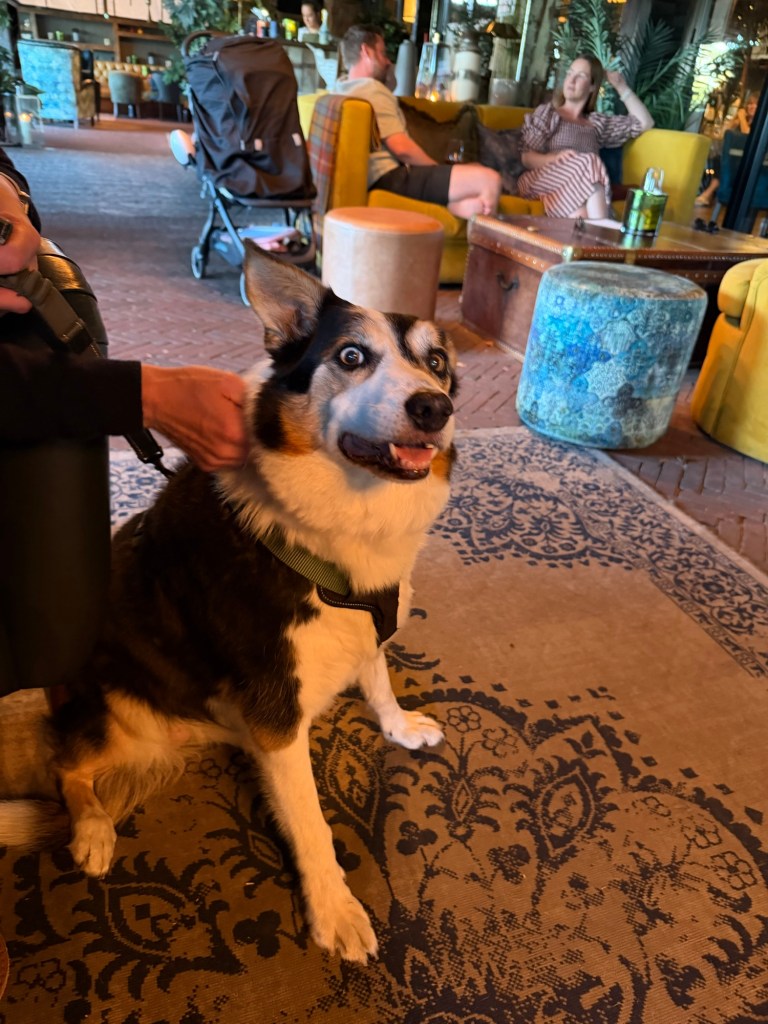
    Even this past week, our birthday travel plans fell away so we could stay home and prioritize our dog at the end of her life. But in true fashion, my family stepped in, organizing things on the fly so I could spend quality time with my friends and family—ensuring we still celebrated, surrounded by love, despite the shift.

    Over the years I’ve learned that a life doesn’t have to go to plan to be a good one. The days before my fortieth birthday taught me something simple: I’d choose people over achievement, happiness over endless hardship, and truth over comfortable uncertainty. Most of all, I’d choose this life—different though it is.

    Years ago, sitting in hospital, I didn’t know what the future held or even if I’d make it to 40. If I could speak to that version of myself now, I’d tell him only this: Life’s going to be different, but not bad .

    Forty feels like a good age to finally believe it.

    This post is dedicated to the memory of our eternal love: Marina the Border Collie. I miss you, my daft old bat
  • Living contradiction

    Jul 15th, 2026

    One thing recovery and rehabilitation and recovery time have taught me is that two things can be true which, by its nature, is contradictory

    I appreciate and sometimes need help, but not too much help. I stubbornly fight for my independence but am acutely aware I can’t do everything

    I need help getting to places while I can’t drive, but not planning my time or organising things, that feels controlling not supportive

    I might ask for suggestions on things I have chosen, but that doesn’t mean change or select it without giving me freedom

    I’m aware I’m a living contradiction.

    Having that awareness, but an inability to change it is contradictory too.

    Two things can be true; which feels infallible to write and doesn’t sit well with me but it is accurate.

  • Milestones and regular stones

    Jul 7th, 2026

    Rehabilitation seems to have a fascination with milestones.

    The first step. The first drive. The first day back. The first time doing something you couldn’t do before.

    They’re the moments people ask about. The moments worth celebrating.

    But what happens when the milestone doesn’t happen?

    My arm and hand haven’t made the progress I hoped they would. There hasn’t been a breakthrough. No dramatic before-and-after photo. No moment where everything suddenly changed.

    For a long time, I waited for that milestone.

    Recently I’ve started wondering if perhaps the problem is the word itself.

    A milestone sounds important. Obvious. Something that stands out.

    But perhaps most milestones are just stones.

    Unexciting. Present. Easy to overlook while you’re busy living a life.

    While I was waiting for progress in my arm and hand, life kept happening.

    .

    Weekends happened.

    Birthdays happened.

    Friends and family happened.

    Work happened.

    Pub visits happened.

    Rugby happened.

    Not because I stopped wanting more recovery. Not because I’d reached acceptance. And certainly not because I wouldn’t take more function tomorrow if it were offered.

    Life just carried on.

    The milestone I was looking for never arrived. At least not in the way I’d imagined.

    Maybe I was so focused on one stone that I missed all the others.

    The ability to make plans again.

    The confidence to book things in advance.

    The ordinary frustrations of everyday life.

    The things that have become normal enough that I barely notice them anymore.

    Perhaps that’s the thing about milestones.

    We imagine them as flags planted at significant moments.

    In reality, they might just be stones. Quietly appearing along the path while we’re busy looking further ahead.

    I’m not sure there’s a conclusion to that.

    My arm and hand haven’t made progress.

    I keep going anyway.

    Maybe that realisation is the milestone.

    Or maybe it’s just another stone.

  • I’m not ok (currently)

    Jun 25th, 2026

    June 2026.

    3 years ago when I had my stroke I knew recovery was going to be long “it’s a never ending marathon”~J but I had no idea how relentless it becomes, the constant hope, the failures, the knock backs , the diversions, I feel like I’ve been in heavy combat for 3 years. I had always expected summer 2026 to be a big one (for some unnamed reasons).

    And it appears that’s not the case.

    Not for want of trying.

    I still commit to a hefty amount of rehab but my left arm and hand refuse to work

    I work professionally in a role I find real value and passion in. But mourn being an active clinical person

    I manage a lot of my health despite additional conditions: epilepsy, hypothyroidism, photosensitive skin, it bares the old adage of ‘no one knows your body better than you’ -I sometimes need someone who is willing to listen and help me get to my goals but that often isn’t easy. Disjointed teams and workflows exist which I shouldn’t have to battle but do, sometimes I nudge things in a direction and hope.

    Driving- I’ve had more time not driving than I have driven post stroke even learning with my adapted car but health issues have repeatedly blocked it. I should, in theory, be ok to drive very very soon but this depends on the DVLA sorting their side out and previous experience is they won’t do it in the time scale. I’m trapped when I’m alone, I’m at the whim and mercy of other people; while I appreciate help I long for that freedom of “yeah I’m going there in an hour I’ll hop in the car” or “I fancy a walk around somewhere I’ll go and do that”

    Speaking of cars, it appears mine is doing its swan song. It’s been undrivable for 6 weeks and in the garage for repair for 3. I’m hoping it can’t be repaired because I get to order an urgent replacement 6 months earlier than I should; I’ve already selected my next car and am full of anticipation to get it ordered. Or my current one back if the dvla say I’m safe.

    There’s been a thing in the background for 3 years I don’t openly discuss but has peaks and troughs of activity, one day I’ll be able to close that door but currently it’s keeping my brain occupied

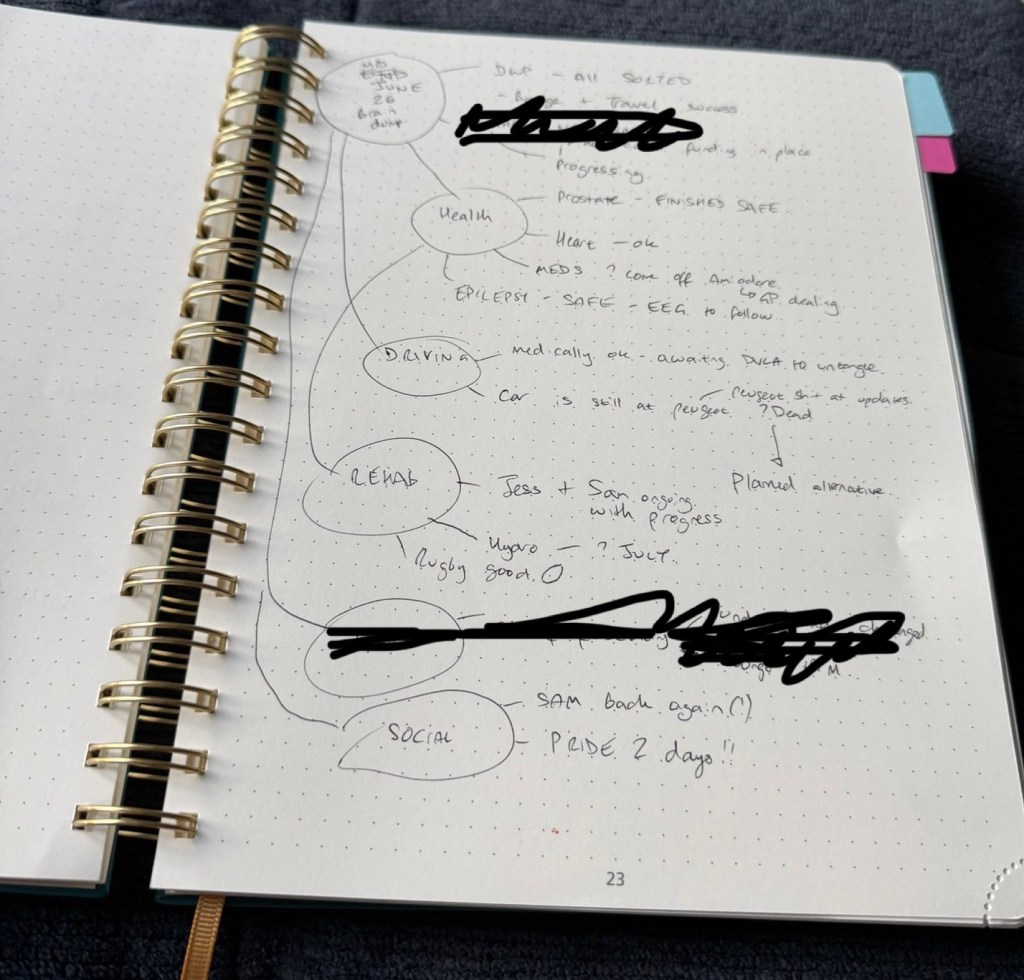
    At time of writing we’re experiencing a heatwave in England with temperatures over 30oC, I’m not sleeping well, my brain has turned to wool through a combination of tiredness, dehydration and medication which is impacting my mood, physical coordination and mental processing. Combine these with a restless mind trying to work on all the above things and I’m holding my hand up and saying I’m not ok at the moment.

    However the weather looks to take a cooler turn tomorrow and we go away next week, for a lot of quiet and rest time which is perfectly timed by sheer fluke.

    When my head is mega busy like now I draw it all out to get it out and give myself a visual release
  • Yellow socks

    Jun 10th, 2026

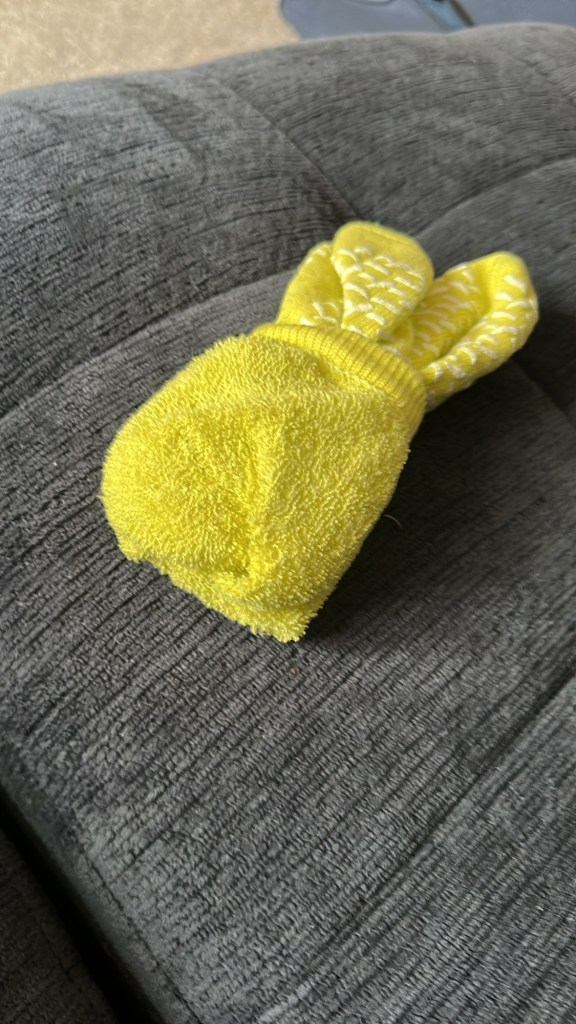
    We recently had a big clear out in our house.

    During which we found a pair of yellow socks.

    In an acute hospital setting yellow socks are a visual identifier to staff that the person wearing them is a “falls risk” meaning they have poor mobility, balance or all of the above.

    I spent 8 weeks of 2023 wearing those socks 24 hours a day. I didn’t have the physical ability to stand. 3 years on I walk, independently for miles.

    So when we stumbled. (Excuse the pun) on to a remaining pair at home, I had a weird mix of emotions but the best emotion was the pure joy of being able to put that stray pair of socks in a bin.

1 2 3 … 15
Next Page→

Blog at WordPress.com.

Loading Comments...
  • Subscribe Subscribed
    Stroke and mirrors

    Have a WordPress.com account? Log in now.

  • Stroke and mirrors
    View site in Reader
    Manage subscriptionsSign upLog in
    Report this content
    Collapse this bar